Crypto is having an uncomfortable year.
A list compiled by researcher Stacy Muur counted 82 projects and protocols that announced closures in 2026. DeFiLlama, using a broader methodology, had already recorded 100 wind-down announcements by August. The two numbers should not be added or treated as a definitive census. A protocol can close its development company while leaving smart contracts live, a chain can migrate, and a product can disappear while its parent survives.
The direction is still hard to ignore. DeFiLlama found that lack of product-market fit was the most frequently cited reason, followed by depleted runway, insufficient revenue and strategic pivots. The projects in its sample had collectively raised about $1 billion, and nine had raised more than $50 million each. Capital bought time. It did not create durable demand.
At the same time, some of crypto's most recognisable builders and investors are looking toward artificial intelligence.
Sam Blackshear, the creator of the Move programming language and a co-founder of Mysten Labs, left his operational role in the Sui ecosystem to join Anthropic and work on defensive security research. He said he would remain an adviser to Mysten and involved with Move, so this is not a clean break with crypto.
Kyle Samani, the co-founder and former managing partner of Multicoin Capital who led its early Solana investments, stepped down from the firm at the start of 2026. His next areas of exploration include AI, longevity and robotics, while he retains crypto-related board roles and investments.
Then, on 22 October, one of the industry's most symbolic brands changed its name. Andreessen Horowitz expanded the mandate of a16z Crypto and renamed it a16z Frontier. The new fund will invest beyond crypto in technologies including AI, autonomous machines and new networks.
Is this evidence that the crypto revolution failed?
Possibly the opposite. Crypto may be losing its status as a self-contained industry precisely because parts of it are becoming infrastructure.
A financial revolution has a narrow audience
Bitcoin sits partly outside this discussion. Its central proposition is monetary: a scarce, permissionless asset and settlement network. The rest of the crypto economy has promised a broader transformation through stablecoins, tokenisation, on-chain markets and programmable payments.
Those technologies are finding real uses. Banks issue tokenised assets. Fintech products settle with stablecoins. Payment companies integrate blockchains behind familiar interfaces. Trading, collateral and liquidity can move through software rather than a chain of manual intermediaries.
But this remains primarily a financial revolution, and financial plumbing rarely inspires mass enthusiasm.
Faster settlement, continuous markets and liquid tokenised securities can be economically important without giving an ordinary user a reason to learn what a rollup or smart contract is. Most people do not celebrate a better messaging standard between banks. They notice only whether a payment works.
Artificial intelligence is different. It reaches into work, education, medicine, software, research and creative production. Its usefulness is visible at the interface. That gives talented engineers an enormous surface of unsolved problems and gives investors access to markets far larger than crypto trading.
The migration is therefore rational. It does not prove that blockchain technology has no value. It suggests that the value may sit lower in the stack than its promoters once expected.
The user crypto was designed for
An autonomous software agent does not care about decentralisation as an ideology. It cares whether it can discover a service, understand the price, obtain permission to spend, complete a payment and verify the result without waiting for a person or a bank's business hours.
That requirement resembles the strongest properties of crypto rails.
Stablecoins can move globally at any hour. Smart contracts can enforce programmable conditions. Wallets and signatures can give software bounded authority. Low-cost networks can settle payments too small for a traditional card fee. Public ledgers can give machines a shared record without requiring every service provider to integrate with the same private database.
This is no longer purely theoretical. Coinbase's x402 protocol turns the web's long-reserved “Payment Required” status into a payment flow. A service can respond to an agent's request with a price, the agent can pay in a stablecoin, and the request can continue without an account, invoice or human checkout.
The x402 Bazaar adds discovery. Through its Model Context Protocol interface, an agent can search a catalogue of paid endpoints, inspect their descriptions, prices and schemas, then call a selected service. Payment creation and settlement can happen inside that tool call.
The important innovation is not that an AI can hold a token. It is that software can compare and purchase capabilities dynamically. Data, compute, research, storage or an API response becomes a machine-readable market.
That changes who crypto products may need to attract.
Marketing to machines
For a human user, a crypto application competes through design, community, incentives and brand. For an agent, the deciding factors may be different: clear schemas, predictable output, uptime, latency, price, permissions, reputation and a settlement method the software can use automatically.
A protocol may eventually optimise its documentation for machine discovery just as a website today optimises for a search engine. It may publish capability manifests and price schedules so agents can compare it with competing services. Reliability data and cryptographic attestations could matter more than a social-media following.
Coinbase is not alone in seeing this market. Visa is developing its own agentic commerce infrastructure, including registries, trust signals and tokenised payment credentials. Its joint work with Artemis has also examined live on-chain agent payments. Traditional networks can bring consumer protection, merchant relationships, identity systems and regulatory experience that open crypto protocols do not automatically provide.
The competition will not be settled by ideology. Agents will route activity toward the system that offers the best combination of cost, reach, reliability and control.
Crypto has an advantage for machine-native micropayments. Visa's analysis notes that many early agent payments are worth only fractions of a cent, a level at which a fixed card fee can exceed the payment itself. Traditional payment companies, however, have an advantage when an agent buys a physical product for a human and chargebacks, fraud allocation or customer service matter.
The likely outcome is not one universal rail. Agents may use stablecoins to purchase data or compute, bank money for payroll and cards for consumer transactions, while the person who delegated the task sees only the final result.
Adoption without believers
The agent economy still has serious unresolved problems.
An autonomous buyer needs limits on what it may purchase and how much it may spend. Services need to distinguish legitimate agents from cheaply generated spam. Someone must manage compromised credentials, erroneous payments, taxes, sanctions and disputes. A payment can be technically final and still economically wrong.
These constraints could prevent open crypto rails from reaching the imagined scale. They could also favour regulated intermediaries that hide blockchain settlement behind familiar controls. If so, the winning crypto infrastructure may look much less decentralised than early advocates expected.
The early transaction volumes are also small compared with global commerce. A working protocol is evidence of feasibility, not proof of mass adoption. Billions of agents paying each other remains a scenario, not a forecast.
Yet the scenario resolves one of crypto's oldest contradictions. The industry spent years trying to persuade humans to care about its architecture. AI agents may use that architecture without caring at all.
This also puts the 2026 shakeout in a different light. Many projects may still fail because they built products for an audience that never arrived. The surviving infrastructure could become valuable when connected to a new audience with entirely different needs.
The great irony would be for AI to absorb crypto's talent, capital and attention, then create the demand that finally makes its payment rails indispensable.
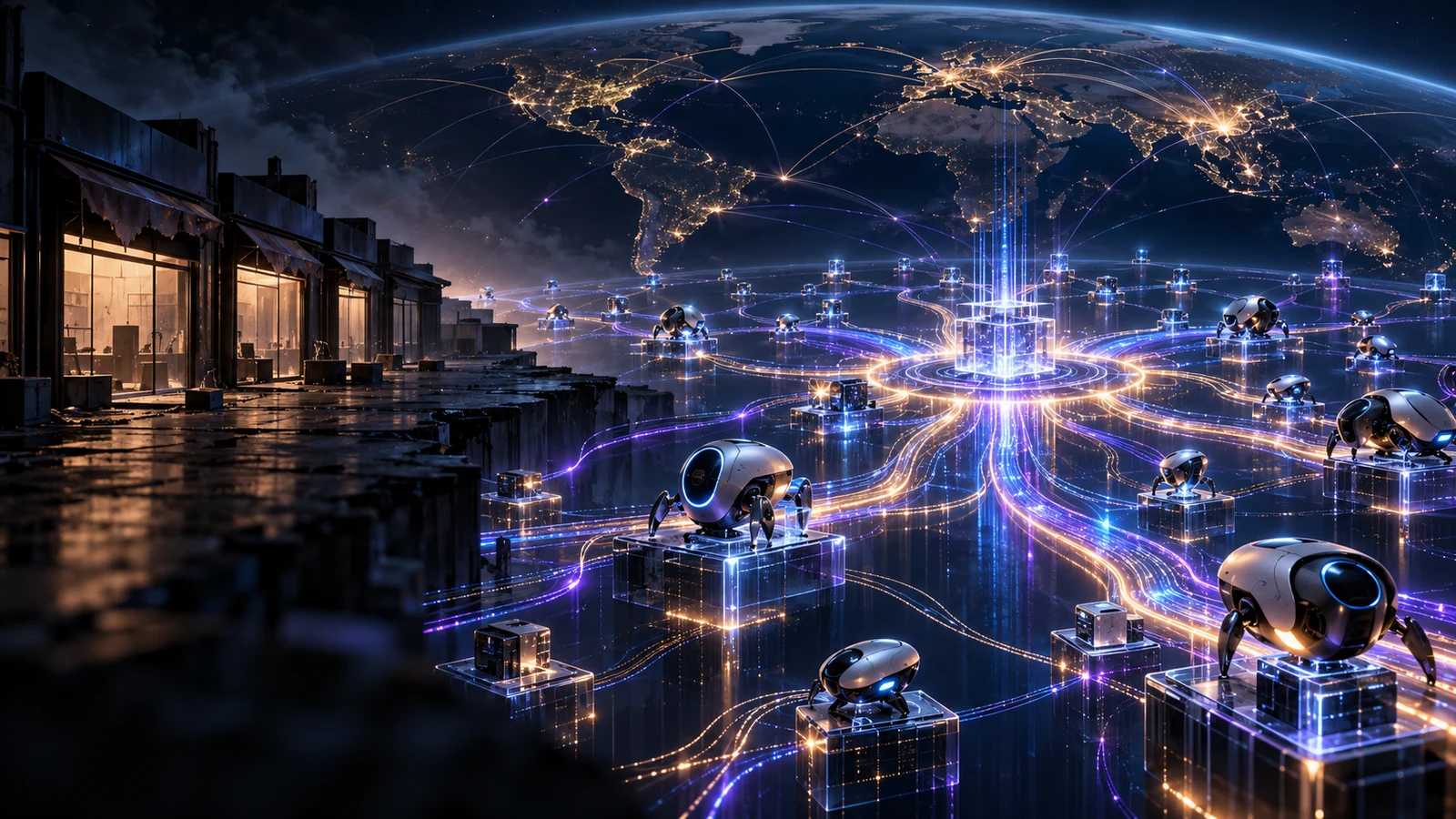
Crypto's next billion users may not download wallets, memorise seed phrases or call themselves users. They may be pieces of software, acting for people who never know a blockchain was involved.
This publication is market analysis, not a recommendation to buy or sell.